
come to the table
Where hostility is broken down and unity is built.
the past can't stay in the past
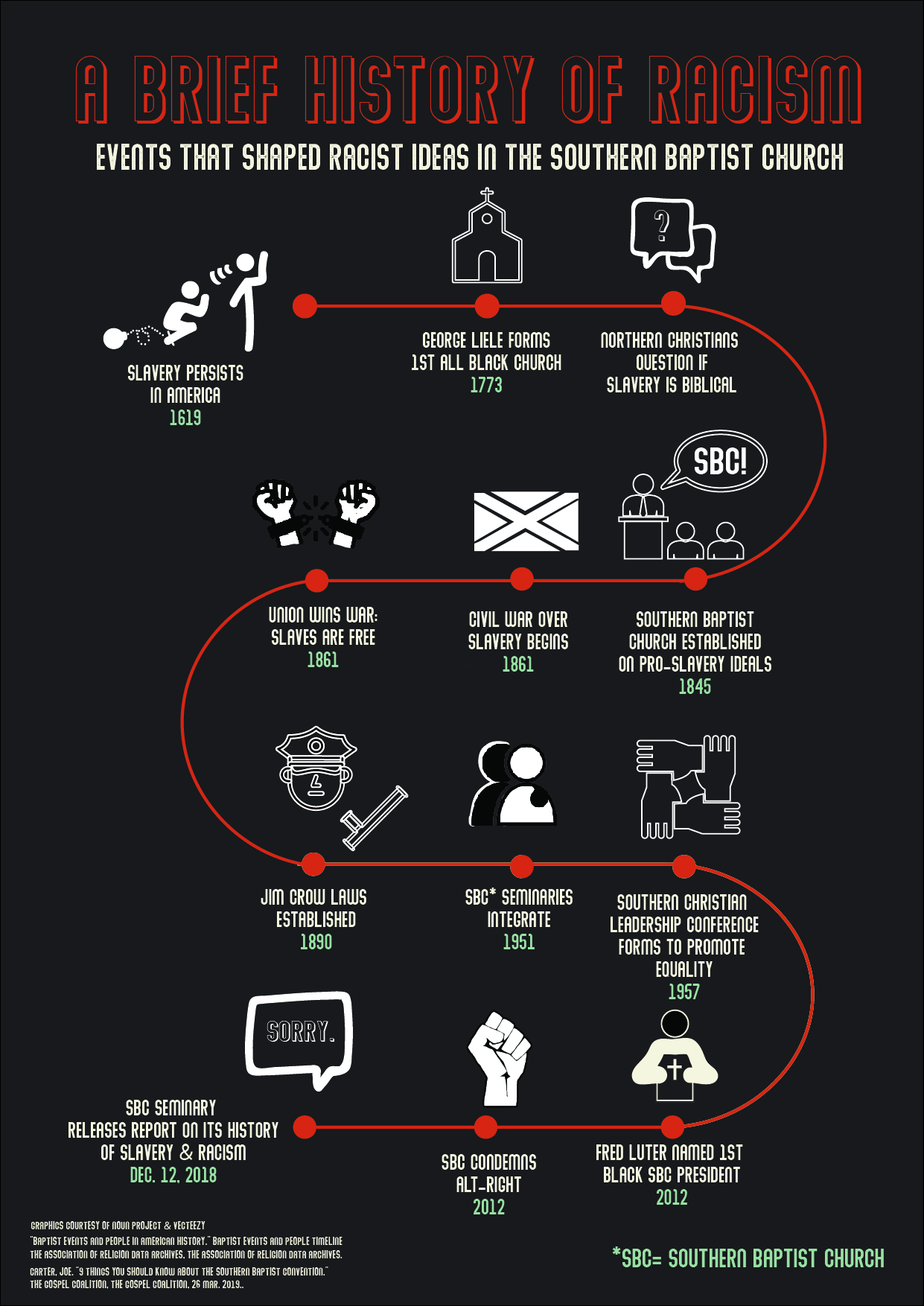
The largest Protestant denomination in the United States, the Southern Baptist Convention, came into existence in 1845 because it disagreed with the northern Baptist’s abolitionist ideals.
Now fast-forward 173 years.
On December 12, 2018, the Southern Baptist Theological Seminary (SBTS) released a 71-page report describing the use and ownership of slaves that were present in the formation of the seminary.
For decades, Christians in the Southern Baptist Convention (the collection of churches in the Southern Baptist denomination) have chosen to ignore and neglect the racism that has defined its history. Recently, a movement has swept across the South to confront this issue head-first.
“We will not attempt to rewrite the past, nor can we unwrite the past.” Albert Mohler, Jr. is the current president of the Southern Baptist Theological Seminary which is based in Kentucky. Mohler has brought attention to the seminary’s wrongdoings and hired current and former faculty to conduct this report on the school’s association with slavery. The president promised to not withhold any information or edit the report, but release the full account to the public.
The report exposes the four founders of the seminary for owning up to 40 slaves each. In addition, it outlines other former faculty’s involvement in slave ownership, as well as the school’s support for segregation and Jim Crow laws.
The SBTS has no confederate statues to take down, nor plaques in honor of the slave-owning founders. Some buildings, however, are named after the founders but Mohler explains that renaming the buildings would be hiding the past instead of allowing current students and faculty understand the history of the seminary.
Racial division is still present in the majority of Southern Baptist churches in America today. The residual tension from slavery effects churches by splitting congregations by race, commonly referred to as “Black church” or “White church.”
Lauren Williams is an African American student at UNC-Chapel Hill. During her time in college, she feels the division between Christian community and her other friends. She notices that her Christian friends are white, but it is important to have minority believers in her life. “It’s sad that it’s this ways,” Williams explains, “because I know Christianity isn’t assigned to a race.”
If the Southern Baptist Church believes that God made all man in His image, what is the SBC going to do about the issue of being established on pro-slavery ideals?
the question of unity
“There is no question that our community, our university, and our nation face division. We are divided along socioeconomic lines, political lines, and, perhaps most apparently, ethnic and racial lines. At times, we have reason to be optimistic about unity – we make strides forward, embrace one another, fulfill goals – but, if you are like me, you are more often than not discouraged, pessimistic, and even hopeless. When will unity come? How will it be achieved? Some have proposed politics, social activism, and education. But what about the church? Do God’s people have any place in the conversation on racial unity? Or are they simply another futile device, doomed to failure?”
. . .
Matt Gilleskie, UNC'19
So now what?
The Summit Church, a Southern Baptist church based in North Carolina, has decided to make racial unity a priority this year.
In the history of the Southern Baptist Convention, there has been more talk than action in regards to racial reconciliation which has caused frustration among the minority members of the congregation. More often than not, movements centered around promoting racial equality will rise high then fade out as interests focus on the newest social justice trend.
After pastors of the Summit Church attended a conference in commemoration of Martin Luther King, Jr., they saw that the church needs achievable goals that must be attained through pracital steps- two elements that the church has completely lacked.
At the beginning of 2019, a group of pastors, elders, and faithful members of the Summit Church created a board to head the Commission for Oneness and Reconciliation and Equity (CORE). This commission has a goal to increase awareness of racism in the church through starting conversations, addressing individual racial biases, and emphasizing the importance of having friends that look and think in different ways than you.
The commission is starting with gauging how the people of color in the congregation have been hurt or neglected by the church through meetings with various focus groups and surveys. Eventually the CORE team will impliment obtainable steps for the church members to partake in.
engage
Invite
Bring others into your home, life, and love.
Learn the history
Get educated on the suffering minorities have endured in America.
Connect
Connect with people who are different from you, listen to their story, and ask thoughtful questions.
Follow the conversation on Instagram @unityatunc
Sources
McGee, Charlie. “Protesters Disrupt United Daughters of the Confederacy Meeting.” The Daily Tar Heel, 2 Dec. 2018, www.dailytarheel.com/article/2018/12/udc-protest-1202.
“BAPTIST EVENTS AND PEOPLE IN AMERICAN HISTORY.” Quality Data on Religion, The Association of Religion Data Archives, www.thearda.com/timeline/tlDenom5.asp.
Emerson, Michael. Divided by Faith: Evangelical Religion and the Problem of Race in America. Oxford University Press, 2000